

On-Page vs Off-Page SEO (Explained)

KeyTakeaways
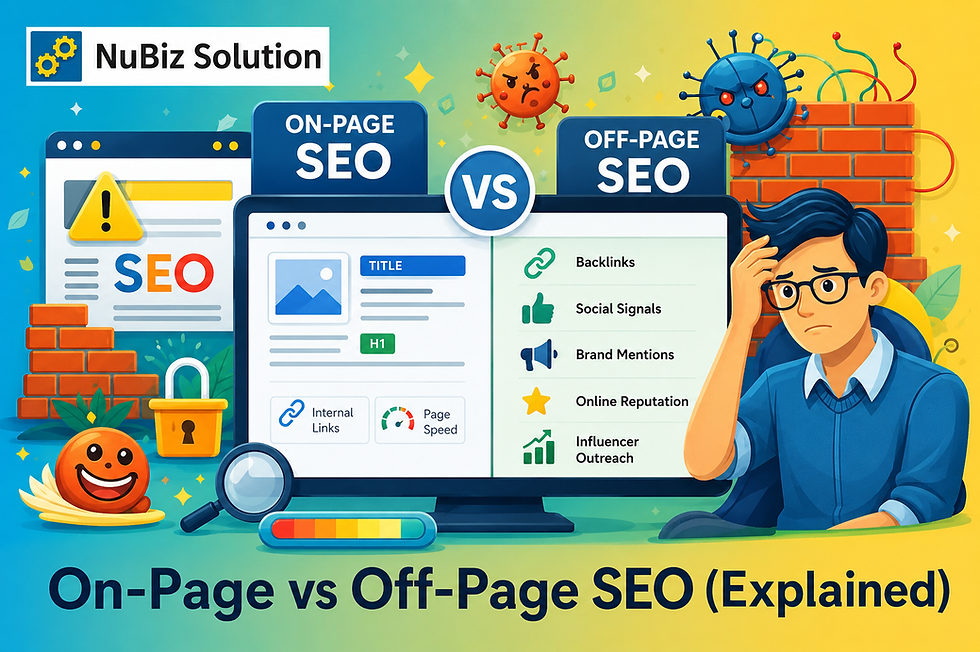
On-Page SEO: Optimize content for user intent, headings, titles, meta, URLs, internal links, speed, mobile, and navigation so search engines understand relevance and users stay engaged.
Off-Page SEO: Build authority via high-quality backlinks, brand mentions, reviews, and social signals. Quality backlinks matter more than quantity to boost trust.
Key difference: On-Page improves relevance/experience; Off-Page builds trust/authority. Both are essential; without On-Page, engines misread content; without Off-Page, sites lack authority to rank.
AI, tech, local: AI, tech, local: AI favors helpful, comprehensive content. Strong site tech (speed, mobile, structure) impacts rankings. Local SEO needs profile optimization, reviews, and citations for map rankings.
Bottom line: Neither is more important; integrate On-Page and Off-Page for sustainable growth, higher rankings, and more organic traffic.
If you've been researching ways to improve your website's visibility on Google, you've probably come across the terms On-Page SEO and Off-Page SEO. These two strategies are often discussed together because they form the foundation of successful search engine optimization. However, many business owners struggle to understand how they differ and why both are necessary.
The reality is that search engines want to rank websites that are both useful and trustworthy. You can have excellent content, but if nobody references or recommends your website, it may struggle to compete. Likewise, you can earn plenty of backlinks, but if your website offers a poor user experience, visitors won't stay long enough to convert into customers.
Understanding how these two areas work together is essential for building a sustainable digital marketing strategy.
Whether you're launching a new website or improving an existing one, the right SEO strategy can make a significant difference. Reach out today to learn how professional optimization can improve your online visibility.
Understanding Search Engine Optimization
Before comparing On-Page and Off-Page SEO, it's important to understand the bigger picture.
Search engine optimization is the process of improving a website so that it appears more prominently in search engine results. The ultimate goal is simple: attract more qualified visitors without relying solely on paid advertising.
When someone searches for information online, search engines evaluate thousands of potential results in a fraction of a second. Their job is to determine which pages are most relevant, trustworthy, and useful for the searcher's query.
To make those decisions, search engines analyze hundreds of factors. Some of those factors exist directly on your website, while others come from external sources across the internet.
That's where On-Page and Off-Page SEO come into play.
What Is On-Page SEO?
Expert On-Page SEO refers to everything you can directly control on your website. It involves optimizing individual pages so search engines can better understand your content and users can easily find the information they're looking for.
Imagine walking into a well-organized store. Products are clearly labeled, aisles are easy to navigate, and helpful information is available wherever you need it. That's essentially what good On-Page SEO accomplishes for a website.
Search engines want clear signals about what a page is about. They look at your content, headings, images, title tags, internal links, and overall user experience to determine relevance.
Why Content Is the Foundation of On-Page SEO
Content is often described as the backbone of SEO, and for good reason.
Every search begins with a question. Whether someone is looking for a product, service, tutorial, or answer, they're searching for information. Your content is what helps satisfy that need.
Strong content does several things at once. It helps search engines understand your expertise, keeps visitors engaged, and increases the likelihood that users will take action.
High-quality content generally:
Answers specific questions
Addresses user intent
Provides accurate information
Uses clear and natural language
Beyond content itself, factors such as page speed, mobile responsiveness, and website navigation also influence how search engines evaluate your site.
What Is Off-Page SEO?
While On-Page SEO focuses on your website, Off-Page SEO focuses on everything that happens outside of it.
A useful way to think about Off-Page SEO is as your website's reputation.
Imagine two businesses offering similar services. One has hundreds of positive recommendations, industry mentions, and loyal customers talking about them online. The other has very little recognition.
Most people would naturally trust the first business more.
Search engines work similarly.
They look at external signals to determine how authoritative and trustworthy a website appears. The stronger those signals, the more confidence search engines have in recommending that website to users.
Why Backlinks Still Matter
Despite constant algorithm updates, backlinks remain one of the strongest indicators of authority.
When a reputable website links to your content, it essentially tells search engines that your information is worth referencing.
Not all backlinks carry the same value, though.
A single link from a respected industry publication may provide more value than dozens of links from low-quality websites. This is why quality consistently outweighs quantity in modern SEO.
Looking for the Right Digital Solution for Your Business? Explore our range of services designed to help businesses improve their online presence, generate leads, and achieve sustainable growth. Discover Our Services
The Biggest Difference Between On-Page and Off-Page SEO
Comparison Factor | On-Page SEO | Off-Page SEO |
Main Purpose | Helps search engines understand what your website and content are about. | Helps search engines determine the credibility and authority of your website. |
Primary Focus | Focuses on improving relevance and user experience. | Focuses on building trust, reputation, and website authority. |
Where It Happens | Done directly on your website pages. | Done outside your website through external activities. |
Key Elements | Content optimization, keywords, meta tags, headings, URLs, internal linking, and page structure. | Backlinks, brand mentions, social signals, online reputation, and external references. |
Impact on Ranking | Improves how search engines understand and match your content with user searches. | Increase trust signals that help your website compete for higher rankings. |
Importance | Without On-Page SEO, search engines may not understand your content properly. | Without Off-Page SEO, search engines may not consider your website authoritative enough. |
How AI Is Changing SEO
The rise of artificial intelligence is transforming how search engines evaluate content.
Modern algorithms are becoming increasingly effective at understanding natural language, context, and user behavior. Instead of focusing solely on keywords, search engines now evaluate whether content genuinely satisfies a searcher's needs.
As a result, AI SEO optimization has become a growing area of focus for businesses that want to remain competitive.
This doesn't mean AI replaces traditional SEO principles. Instead, it reinforces the importance of creating helpful, comprehensive, and user-focused content.
The websites that provide real value are often the ones that benefit most from these technological advancements.
Why Website Development Impacts SEO
Many people think SEO begins after a website is launched, but that's not always the case.
The way a website is built can significantly influence its search performance. Factors such as loading speed, mobile usability, navigation structure, and technical accessibility all affect rankings.
For example, businesses investing in Wix web development should ensure their websites are designed with SEO best practices in mind from the start.
Even excellent content can struggle to perform if technical issues prevent users or search engines from accessing it efficiently.
Local SEO and Authority Building
For businesses serving specific geographic areas, local visibility can be just as important as national rankings. A strong local presence often involves optimizing business profiles, earning customer reviews, and building local citations.
Many companies work with a local business SEO service to improve visibility in map results and location-based searches. These efforts help establish trust within a community while supporting broader SEO goals.
Which Is More Important?
One of the most common questions in digital marketing is whether On-Page or Off-Page SEO matters more. The honest answer is neither.
A website with excellent content but no authority may struggle to rank. Likewise, a website with strong authority but poor content may fail to convert visitors.
The most successful SEO strategies treat both as equally important pieces of a larger puzzle.
When On-Page and Off-Page efforts work together, they create a powerful foundation for sustainable growth.
Want to Learn More About Growing Your Business Online? Explore more guides on SEO, local search optimization, website performance, and digital marketing strategies designed to help small businesses increase visibility and attract more customers. Read More SEO & Marketing Guides.
Final Thoughts
The debate between On-Page and Off-Page SEO isn't about choosing one over the other. Instead, it's about understanding how they complement each other.
On-Page SEO helps search engines understand your content and provides users with a positive experience. Off-Page SEO builds trust, authority, and credibility across the web. Together, they form the core of successful search engine optimization.
Businesses that invest in both areas are typically better positioned to improve rankings, increase organic traffic, and achieve long-term success in an increasingly competitive online environment.
Frequently Asked Questions
1. What is On-Page SEO?
On-Page SEO refers to everything you directly control on your website, optimizing individual pages so search engines understand content and users find information easily. It includes content optimization, keywords, meta tags, headings, URLs, internal linking, page structure, page speed, mobile responsiveness, and navigation. Like a well-organized store with clearly labeled products, good On-Page SEO gives search engines clear signals about what pages are about.
2. What is Off-Page SEO?
Off-Page SEO focuses on everything happening outside your website, essentially your website's reputation built through external signals like backlinks, brand mentions, social signals, online reputation, and external references. Search engines use these signals to determine authority and trustworthiness; stronger signals mean more confidence in recommending your site. Imagine two businesses: one with hundreds of positive recommendations and industry mentions, the other with little recognition.
3. What is the difference between On-Page and Off-Page SEO?
On-Page SEO helps search engines understand what your website/content is about by improving relevance and user experience directly on your pages (content, keywords, meta tags, headings, URLs, internal links). Off-Page SEO determines credibility and authority by building trust/reputation outside your website (backlinks, brand mentions, social signals, online reputation).
4. Which is more important: On-Page or Off-Page SEO?
Neither is more important; both are equally essential pieces of the larger SEO puzzle. A website with excellent content but no authority struggles to rank; a website with strong authority but poor content fails to convert visitors. Most successful SEO strategies treat both as equally important. When On-Page and Off-Page efforts work together, they create a powerful foundation for sustainable growth, improved rankings, increased organic traffic, and long-term success.
5. Why is content the foundation of On-Page SEO?
Content is the SEO backbone because every search begins with a question; users seek a product, service, tutorial, or information. Strong content helps search engines understand expertise, keeps visitors engaged, and increases the likelihood. High-quality content answers specific questions, addresses user intent, provides accurate information, and uses clear natural language.
6. Why do backlinks still matter in Off-Page SEO?
Backlinks remain one of the strongest authority indicators. When a reputable website links to your content, it tells search engines your information is worth referencing. Not all backlinks carry the same value; a single link from a respected industry publication may provide more value than dozens from low-quality websites. This is why quality consistently outweighs quantity in modern SEO, making backlinks critical for building trust and authority outside your website.
7. Where does On-Page SEO happen?
On-Page SEO happens directly on your website pages, everything you control and optimize within your site, including content, keywords, meta tags, headings, URLs, internal linking, page structure, images, and user experience. Search engines analyze these on-site factors to determine relevance and match content with user searches.
8, Where does Off-Page SEO happen?
Off-Page SEO happens outside your website through external activities, including backlink building, brand mentions on other sites, social media signals, online reputation management, customer reviews, and external references across the internet. These external signals build trust, reputation, and authority that search engines use to evaluate credibility.
9. How does AI change On-Page and Off-Page SEO?
AI transforms how search engines evaluate content by becoming increasingly effective at understanding natural language, context, and user behavior. Instead of focusing solely on keywords, engines now evaluate whether content genuinely satisfies the searcher's needs. AI SEO optimization reinforces the importance of creating helpful, comprehensive, user-focused content rather than replacing traditional SEO principles.
10. What are the key On-Page SEO elements?
On-Page SEO elements include content optimization (quality, relevance, user intent), keyword placement, meta tags (title tags, meta descriptions), headings (H1, H2, H3), URLs (clean, descriptive), internal linking, page structure, images (optimized with alt text), page speed, mobile responsiveness, and navigation. These elements help search engines understand content relevance while providing users with a positive experience.
11. What are the key Off-Page SEO elements?
This include backlinks (quality from reputable sites), brand mentions across the internet, social signals (shares, engagement), online reputation management, customer reviews, external references, influencer partnerships, content marketing, and local citations. These external signals build trust, authority, and credibility that search engines use to evaluate website worthiness for ranking.
12. How does Local SEO relate to On-Page and Off-Page SEO?
Local SEO combines both On-Page and Off-Page strategies—On-Page includes optimizing business profiles, location pages, and local keywords; Off-Page involves earning customer reviews, building local citations, and establishing community trust. For businesses serving geographic areas, local visibility in map results and location-based searches can be as important as national rankings.
13. Why do businesses need both On-Page and Off-Page SEO?
Businesses need both because On-Page helps search engines understand content and provides users a positive experience, while Off-Page builds trust, authority, and credibility across the web. Without On-Page, engines may not understand content properly; without Off-Page, engines may not consider the site authoritative enough.


Great info